So I’m back in Austin now and I will blame the move and the readjustment for the long absence in writing. But now I’m back to it, and it does make me sad that I’ve had the same post at the top of my page for over a month. Part of the readjusting is finding a job, deciding what you’re going to do with yourself now, in a new city. Cooking would be an ideal way for me to go, but it’s not a career you can just jump into, nor is it very lucrative (not that I’m in it for the money, but it’d be nice to not live with my parents forever). So one way I’m starting small is by cooking for friends at their events and functions. One of my sister’s friends is getting married and we were throwing a wedding shower for her, so I offered my services. My full and complete services, which means not just dessert but dinner too. It was a lot of fun and kept me busy for a few days, but I have to thank the people that cleaned the dishes for me. That would’ve been a whole lot more.
The beauty of arranging this myself was picking and choosing exactly what I wanted for the menu, not having to report for work and be given a to-do list that was already mapped out for me. For desserts, I knew I would do a cheesecake, and went with a chocolate coffee one that I had made before. At the last minute, I decided to do a peach pie for good measure. It was something I had made a lot before and definitely couldn’t hurt. For the third dessert, I picked something new from the Macrina Bakery cookbook, in Seattle, given to me by my friend Leah who has discovered the food scene up there. My one quibble with the book is that it doesn’t have any pictures of the food. I love to see big, colorful pictures of the finished product. And it would’ve been great for this recipe especially as it turned out beautifully. Just reading the name committed me to it: almond cake with mascarpone cream and fresh blackberries.
I changed a few things, as I tend to do. First of all, I was making this the night before the shower, you can’t wait till the last minute for everything. It tells you to put blueberries in between the cake layers, but I didn’t want them running and bleeding everywhere, especially through the icing, so I didn’t put them there and waited until just before serving to top the cake off with them. Also, I didn’t use just blueberries, but blackberries too and I think that’s even better, a mixture of flavors and sizes of berries. Oh, and it didn’t make enough icing but I had run out of mascarpone, so I used a bit of sour cream as a substitute. But a note on that: I couldn’t taste the mascarpone at all, and it tasted just like a regular whipped cream icing, so I was a little disappointed with that, although there were no complaints from any of the guests. This was by far the most popular, a surprise to me, and there was barely any left at the end of the night. Someone even said it could and should be a wedding cake. I think I’d try different icings with it though, cream cheese or perhaps just a regular whipped cream. I was also surprised that it was such a hit after only about 24 hours prior having almost thrown it away completely and ripped all my hair out. Words of warning: this cake is very fragile. You’re supposed to bake it in a springform pan and cut into three rounds, but my springform was occupied (cheesecake), so I put it in two round pans and cut those in half. It did not come out very thick, and one of the layers fell apart completely when I tried to lift it so I couldn’t even use it. So it ended up being three layers for me anyways, but handle with care.
 Almond Cake with Mascarpone Cream and Blackberries and Blueberries
Adapted from Macrina Bakery Cookbook
cake3 eggs
¾ c plain yogurt
2 tsp pure almond extract
½ tsp pure vanilla extract
1 ½ c cake flour
1 ¾ c sugar
¾ tsp baking soda
¾ tsp baking powder
½ tsp salt
1 ½ c finely ground almonds
8 oz (2 sticks) unsalted butter, room temperature
almond syrup1 c sugar
½ c water
2 tsp pure almond extract
pinch of salt
mascarpone cream (I would double this)
1 c heavy cream
¼ c powdered sugar
8 oz mascarpone, room temperature (you can try other cheeses or sour cream)
pinch of salt
blueberries and blackberries1 c fresh berries
1 tsp lemon zest
pinch of salt

Preheat the oven to 325F. Grease and flour your baking pan(s). Combine eggs, ¼ yogurt, almond extract, and vanilla extract in a medium bowl. Mix well with a whisk and set aside. Mix flour, sugar, baking soda, baking powder, salt, and almonds in a medium bowl. Place butter in the bowl of your stand mixer and using the paddle attachment, cream the butter on medium speed for 5 to 8 minutes. The butter will be light and fluffy (unless you’re in Texas and room temperature is more like boiling so the butter will be more melted than fluffy). Add the dry ingredients and the remaining ½ c yogurt. Turn the switch on and off a few times to start bringing the ingredients together, then increase speed to medium and mix for 1 to 2 minutes. Add the egg mixture and mix well, stopping to scrape down the sides and continuing until fully combined. Pour the batter into the prepared pan(s) and bake on center rack of oven for about an hour or until the top is golden brown and a toothpick come out almost clean. Let cool on a wire rack for at least an hour.
For the almond syrup, combine sugar and water in a medium saucepan and mix with a whisk to dissolve the sugar. Cook over medium heat for 2 to 3 minutes, stirring frequently, then remove from the heat and add almond extract. Let cool slightly before using.
When the cakes are cool you can make the icing. Whip the cream and sugar until medium-soft peaks form. Whip the mascarpone with a whisk for 1 to 2 minutes, and then fold the whipped cream into the mascarpone.
When you’re ready to put the cake together, I would suggest macerating the berries first. The book says just for a few minutes, but I did it for a few hours and it turned out great. So mix the berries, ¼ c almond syrup, and lemon zest in a bowl and put in the fridge until ready to top off the cake. Now take the cake and cut in half (if using two pans, very carefully), or in thirds (if using one springform pan). Put a layer on a cake stand and brush with the syrup, then spread icing on top. Top it with another layer, more almond syrup, and icing, until you finish the layers. Ice the top and sides (although the book says not to ice the sides and I would have left it too, but it did not look pretty uniced). Store in the refrigerator and when about to serve, pour the berries on top, letting some of the juice run down the sides. Enjoy.
 my trio of desserts


 Mix together ricotta, powdered sugar, orange zest, and a touch of vanilla extract to your liking. You’ll probably need to pipe this into the shells, otherwise it could get messy trying to fill them. So get your pastry bag and when the chocolate’s dry, fill your cannoli shell.
  The final step is to dip the ricotta edges in the pistachio pieces and then you’re ready to eat.
 Mangia!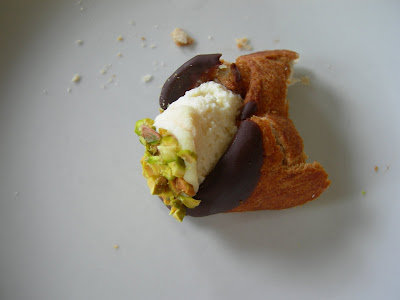
 When it comes to the food though, I know what I want. They do the ever-popular menú del día, but I think the best part is their a la carte menu because it’s another one of those miniature-dish places (think San Sebastian) where you can try a variety of foods, and find something to please everyone at the table.
  Living in Barcelona, you don’t come to expect service as a standout at eating and drinking establishments. You more get the feeling they’re looking at you going, “what are you doing here?” This is not the case at Terrabacus, and it could be attributed to my frequent visits, but I’m willing to take it either way. We became friends with a few waiters in particular, who always spent a little extra time talking to us, seeing how things were going, discussing food. What really convinced me that they paid more attention than your average bear was when I was walking down a busy Barcelona street and a man smiled, waved enthusiastically and said hi to me. I turned my head, confused, and then realized it was my waiter, and he was acknowledging me outside the restaurant. In other places, you barely get that inside a restaurant.
  Little rolls of bacon and cheese. The bacon’s crispy and fatty (naturally) and the cheese oozes as you bite into it. Once again, this one’s not rocket science, but there’s a reason people keep ordering it. And although these some of their dishes might not be new, it’s the presentation that gives it personality, and the little dabs of sauces, some sweet and mango based, some vinegar and sour, all coming together in the end.
  The reason I don’t call these tapas is because they’re not typical tortilla de patatas or jamon or something like that. It’s all real food, just in miniature. So instead of getting a big bowl of pasta and being done with the night, you get a little plate of four purses of pear filled pasta in a creamy goat cheese sauce, plus all the other little plates you want. These purses are reminiscent of I Quattro Leoni in Florence, who has a very similar, equally as rich pasta. These have been a staple since the first trip to Terrabacus.
  So after you have your little dish of pasta, you then get a little plate of my favorite salad of life. And I’m not faking it saying “I love salad” because you’re supposed to because they’re good for you. This really is the best salad there is. There’s foie in it. And carpaccio. And little crunchy bits of puffed rice. And of course greens. Yall, it don’t get any better than that. If this is being healthy, I’m all for it.
  And because you’re so healthy with your salads and smaller-than-normal rations, you might then get a dish of a late-discovered gem: won-ton pasta ravioli, stuffed with mushrooms and served in sauce of foie and truffle oil. You’re probably getting a heart attack just reading this, but there are only three little ravioli, and don’t be turned off but the ‘won-ton’ description. I think that was my problem and the reason for the delayed ordering, which was a mistake. I was picturing something like a mixture between an egg-roll and ravioli, or some sort of deep-fried pasta concoction, which this was not. Instead, it was rich, decadent, amazing pasta.
  Then, you might get a surprise from the kitchen (if you’re as friendly with the staff as we are). I can’t take credit for this one, but one of my friends had talked to them on a prior visit, urging them to make their own take on patatas bravas (inspired by
  There are plenty more tiny delights at Terrabacus, but I’m going to move onto desserts, because they deserver a bit of space too. They have a chocolate coulant, which, unless you cook it too long, is at the top of my list. And they don’t cook it too long here. It’s cakey on the outside and runny batter on the inside. It pairs nicely with a glass of Pedro Ximenez, or another dessert wine offered on the menu.
  One dessert that really surprised me was Kingston cocoa ice cream with confit of orange. I didn’t order it, but tried someone else’s and it was really intense chocolate. I wasn’t expecting that, but I really liked it. I normally reserve my ice cream for my few choice gelaterias, but this was delicious, as rich as a truffle. The pink peppercorns made a tiny appearance in this dessert too.
  If you get a menú del día, there’s the option of cheese for dessert. And after having been in Spain, and now back in America, you really appreciate the Europeans for their cheese. Like I said, I knew what I had, and now I don’t have it (although I can get some of that cheese here, but not all, and definitely not Terrabacus).
 But when they present you with the menu, you just don’t know where to start. There are cold and hot appetizers, nightly specials, and then a regular menu with soups, sushi, sashimi, tempura, etc. Our waiter made it easy for us: told us to do the tasting menu which is mainly pulled from the specials, and if you want you can add things to it. We did, because he said it was for two people, but could easily feed more. By adding a few dishes, it fed four of us. This was best because I was eyeing a few things on the specials and I think we got a total of ten dishes, and then also added a few other things that we couldn’t live without.
  So we’ve got our wine, let’s move onto the food: we started off with an amuse in a little shot glass. It was a puree of Santa Claus melon (never heard of it in my life, but no surprise it’s on wikipedia) with ginger oil. I didn’t feel either way about this, it was just a quick shot and I don’t love melon, but it was fine. I was ready for the real stuff though.
  Next came something from the cold appetizer: sea bass, grapeseed oil, garlic, and black pepper in a citrus vinaigrette. This was very light and fresh, almost too light. The fish was so tender, but I could have used just a pinch more salt or a little more bite to the citrus vinaigrette, although it’s definitely better to be on the light side than the overbearing, too fishy. And there was a crispy fried chunk of fish skin and fin. That was a nice contrast, just a slight crunch to the velvety fish.
  Next was something from the specials, that I was actually thinking of getting. I’m much happier that I got just a taste from lots of plates because there were other dishes that I ended up liking much better. This was Omaaru Ebi: maine lobster, hami melon gazpacho, cilantro puree, and thai chili oil. The lobster was great; just how lobster should be cooked. But the other components I wasn’t too impressed with. It must have been the melon gazpacho and the fact that it said thai chili oil but it definitely needed to be spicier for more dimension.
  Fourth was dish that ranks up there with my favorites. I would go back and get this and be satisfied. Suzuki Viche (makes you wonder what Suzuki means): striped bass, garlic, lemon-thyme vinaigrette, spring onion, and okra. This fish was amazing. That perfect balance of pure fresh fish with a flavor of salt, and it just melted in your mouth. I was also really impressed with the okra; I’m used to fried okra which I don’t love. I think this was my first time to have fresh okra and I liked it. Everything was working in this dish.
  The next dish was also a winner. Hotate Uikyou: seared diver scallops, fennel, lobster mushroom, orange, and cauliflower. I’ve had a newfound appreciation for scallops ever since my first meal at Cinc Sentits, and these kept up their end of the deal. Soft on the inside, crispy browned on the outside. Wish there had been more. The cauliflower and mushrooms were also great, both browned and tasty, but the standout was of course the scallops. I think my mother voted this her favorite.
  Following the scallops we had a dish off the tasting menu that my sister picked. Bacon Steakie: twice-cooked kurobuta pork belly with green apples. Totally amazing. Mouth-watering. Words like these come to mind. You have to get over the fact that there’s fat interspersed with all the meat because that’s what makes it like butter. But it’s crispy and blackened on the outside, so you get a crunch and then almost liquid as the flavorful pork spills over your tongue. My mom said it reminded her of spare ribs that her dad used to cook, a great nostalgic flavor. These were so rich too, if you’re not into skimpy pieces of fish, these will fill in nicely. And I appreciate the mixture of fish and meat during the meal.
  So what dish are we on? Seven? Hamachi Cure: Maplewood-smoked baby yellowtail, yucca, asian pear, and garlic brittle. This was good when you ate a bit of everything together, in one bite. The fish was soft and light, I think to showcase it’s freshness, even though it still preferred the stronger striped bass. But it all pulled together nicely by taking a crunchy yucca chip, some fish, a bit of garlic, and some of the greens and eating it all together.
  Next was another a la carte item that I picked. I just wanted some regular sushi rolls, to kind of give me a basis to compare to. You know, if you’re evaluating goodness, you need level playing ground, like trying vanilla ice cream instead of going for chocolate chocolate chip or whatever. We just got tuna and avocado rolls, and they were superior. It’s been a while since I’ve had sushi in Austin, but like I said before, there aren’t too many places where you could get sushi and meat and fish of this quality. I really liked their maki rolls and wish I had had a plate of different types to try more.
  The ninth dish was another one of my favorites. Gin Dara Miso: pan roasted black cod, miso, white eggplant, shishito, garlic, kumquat. After living in Spain, you get pretty familiar with cod, namely salt cod, and sometimes you don’t come to expect much of it. But this was a completely different experience, a different fish. It was falling apart because it was so tender and well-cooked with the pan roasted sides lending lots of flavor. It was hard for me to focus on all the ingredients in these dishes, especially when the main item would steal the spotlight, but I remember someone saying the white eggplant was ‘buttery.’
  The next dish that came out was the dark horse. Never in my life did I think I’d eat eel (except that time in San Sebastian when I thought they were noodles, but that’s a different story). This was nigiri of grilled fresh-water eel with ginger. Simple and delicious. I’ve stopped turning down most food now, especially if it’s on the tasting menu and the chef thinks I should eat it. I was surprised at how moist it was and kind of meaty, not really like a fish texture. This went down real easy.
  Alright, we got two dishes left on the tasting menu (not including dessert), so stay with me. Wagyu Midori: oak-grilled wagyu short rib, green tomatoes, celery, tarragon, parsley, lemongrass, and green peppercorn. Strange that I had just had Kobe beef for the first time a couple weeks before this. Didn’t taste any different to me. So now I got to try the wagyu. This was noticeably different from other beef. They gave us 5 pieces, so each person took one and I just popped the whole thing in my mouth. It was marbled with lots of fat, and it wasn’t like chewing on a piece of fat at all, but you knew it was there. There was lots of chewing involved. With the fifth piece, we cut it into little squares and divided it, and it was a lot better just by getting a bite-size piece. I still prefer regular beef because it was a texture I’m not used to, a little too much fat mixed in there (don’t ask me why the pork belly works and this doesn’t, it just does). But on this plate, I concentrated on all the other aspects: the green tomatoes were really great. Once again, I’m used to fried green tomatoes, so I was happy to taste their tartness coming out. And what really blew my mind was the ‘celery.’ It looked like cooked green onions but tasted exactly like celery, it was the weirdest thing ever, but fun.
  Finally we got Foie Ume: seared Hudson Valley foie gras, green plums, watermelon radish, lemongrass, black pepper, and concord grape jelly (not Smuckers). This was truly a beautiful dish. All the colors and the image of watermelon on the radish half moons was amazing to look at. I’ve been eating foie now for a few years, but I still like to take it in doses, and usually with toast or bread if I can, to cut the fat. There was no bread to be had. Once again though, if you ate a bit of everything together, a sliver of foie on a faux watermelon, a little sweet jelly, and most crucially, a basil leaf, it molded into perfect pairings inside your mouth. From this I learned that foie and basil could be real friends, I’ve never noticed them coupled together before, but I think more people should experiment with it because I loved it.
  So ended our savory meal, but we still had the dessert to come. They have a separate pastry chef, Mr. Cole does not do that himself. And on the dessert menu there were other things that caught my eye more than what we were served, but I’ll have to save that for next time I go back for a few particular dishes and my Spanish wine. I don’t have a copy of the dessert menu so I’m jogging my memory by looking at the picture and hopefully won’t get it to wrong. Here’s what I’m proposing: beet tatin, lemon gelato, Sicilian pistachios, and some sort of tuille. I mention that first because I have no problem remembering that. It was slightly over-salted. And when I say slightly, I mean really. I forgive them, because it can be broken into tiny shards and top off the tatin or ice cream and be that missing link. But if you get a big bite out of it, watch out. The beet tatin was ok, not great. I liked the gelato and crumbled pistachios best, although I’m more of a heavy, creamy, rich ice cream kinda girl (think chocolate, caramel, hazelnut) and not so much a fruit ice cream, but it sufficed, and I wasn’t exactly starving. The colors on the plate were deep and bright, and the dessert was no doubt thought out, but I’d like to see what the other ones taste like (I seem to remember a peanut butter parfait).

 Now add the garlic, dried chili, a bit more salt, and the three tablespoons of the citrus juice to the powder and grind and mix until you get a paste. Word of advice: it will be very red so be careful not to stain your clothes (it will most likely stain for hands and pestle and mortar temporarily).

